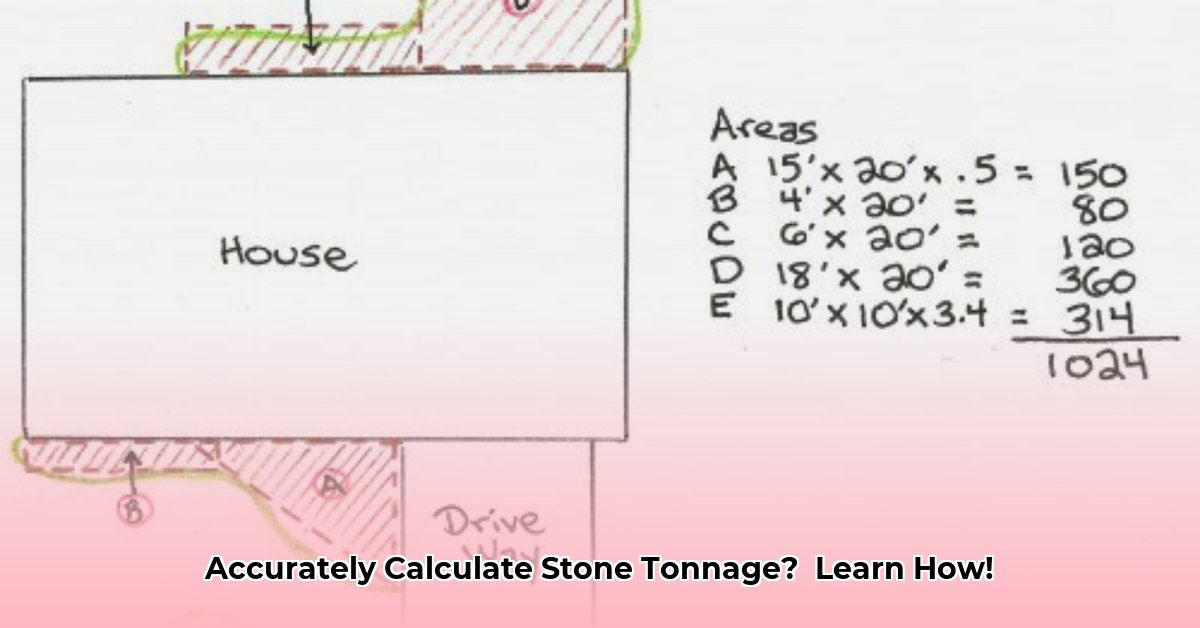
Accurately estimating the amount of landscaping stone needed is crucial for staying on budget and avoiding material shortages or excess. This guide will walk you through the process of calculating stone tonnage for your landscaping projects, comparing two popular online calculators to help you choose the right tool.
Understanding the Fundamentals: Volume and Density
Before using any calculator, grasp the basics. We need to determine the volume of stone required and then convert that volume to weight (tonnage). Volume is calculated by multiplying length, width, and depth of the area to be covered (L x W x D). However, different stones have varying densities (weight per unit volume). Granite, for instance, is denser than gravel, meaning the same volume of granite will weigh more. This density is crucial for accurate tonnage calculation. Always obtain the precise density of your chosen stone from your supplier.
Two Online Calculators: A Comparative Review
Let's examine two popular online stone calculators: Concalculator and Calculatorsforhome. Each offers a slightly different approach.
| Feature | Concalculator | Calculatorsforhome |
|---|---|---|
| Unit Systems | Metric and Imperial | Metric only |
| Shape Calculations | Rectangular and Circular | Rectangular only |
| Cost Estimation | Yes | No |
| Ease of Use | More complex interface | Simpler, intuitive interface |
| Accuracy | Depends on accurate density input; potential for user error in unit conversion | Depends on accurate density input |
Concalculator: A Versatile Option
Concalculator provides flexibility by supporting both metric (meters, kilograms) and imperial (feet, pounds) units. It handles both rectangular and circular areas. Its cost estimation feature is a significant advantage, allowing you to get a price estimate based on the price per unit of stone you enter. However, its more complex interface might lead to input errors if not used carefully. A key advantage? If you're not sure about your measurements, having the option of dual units reduces the likelihood of error.
How to Use Concalculator:
- Select Shape: Choose between rectangular or circular.
- Enter Dimensions: Input the length, width, and depth (or radius and height).
- Select Units: Specify metric or imperial units.
- Input Stone Density: Enter the density provided by your supplier (e.g., kg/m³ or lbs/cu ft).
- (Optional) Input Price: Add the cost per unit to get a cost estimate.
- Calculate: Click "Calculate" to get your tonnage estimate.
Calculatorsforhome: Simplicity at its Core
Calculatorsforhome prioritizes ease of use. It supports only metric units and rectangular areas. This simplicity minimizes the chance of input errors. However, it lacks a cost estimation feature. The trade-off here is speed versus cost.
How to Use Calculatorsforhome:
- Enter Measurements: Input length, width, and depth in meters.
- Select Stone Type: Choose the appropriate stone type from the dropdown menu. The calculator will use the corresponding density.
- Calculate: Click "Calculate" to obtain your estimated tonnage.
Beyond the Calculator: Practical Considerations
While online calculators provide valuable estimations, remember that real-world scenarios are rarely perfect. Uneven terrain, stone breakage, and other unforeseen factors can affect the final amount of stone needed. Therefore, always add a buffer, typically 10-15%, to account for these variances. This extra material will ensure you complete the project without delays. Don't forget about the accessibility of the project site. Difficult-to-access locations may warrant an additional buffer.
Choosing the Right Tool
The best calculator depends on your project's complexity and your needs. For simple, rectangular projects using metric units, Calculatorsforhome's straightforward interface is ideal. Concalculator's versatility is better suited for more complex projects, especially those requiring cost estimations or imperial units. Regardless of choice, always double-check your inputs, and always add extra for waste.
Key Takeaways: Planning for Success
- Accurate stone tonnage calculation is essential for efficient and cost-effective landscaping.
- Online calculators are a helpful tool but have limitations.
- Factor in stone density, shape, and waste when calculating.
- Always add a 10-15% buffer for unexpected variances.
- For complex projects or irregular shapes, consider professional assistance.